
Unit 3: World War II
The death of one man is a tragedy, the deaths of 1 million is a statistic
Someone


1. Causes of the War:
Many of these reasons will sound familiar from previous topics.
In summary, the fundamental causes were: "This is not a peace. It is an armistice for twenty years", as the French Marshal Ferdinand Foch said immediately after learning the terms of the treaty. His prediction was remarkably accurate, as World War II began exactly 20 years later, in September 1939.
-
The unpayable war reparations and the resulting hyperinflation from the crisis, the French occupation of the Ruhr, and the division of Germany in two by the Polish Corridor were unacceptable for Germany. The weakness and low popular acceptance of the Weimar Republic allowed Nazism to take over the streets and, little by little, gain seats in parliament, until in 1933 it obtained a majority at the polls.
-
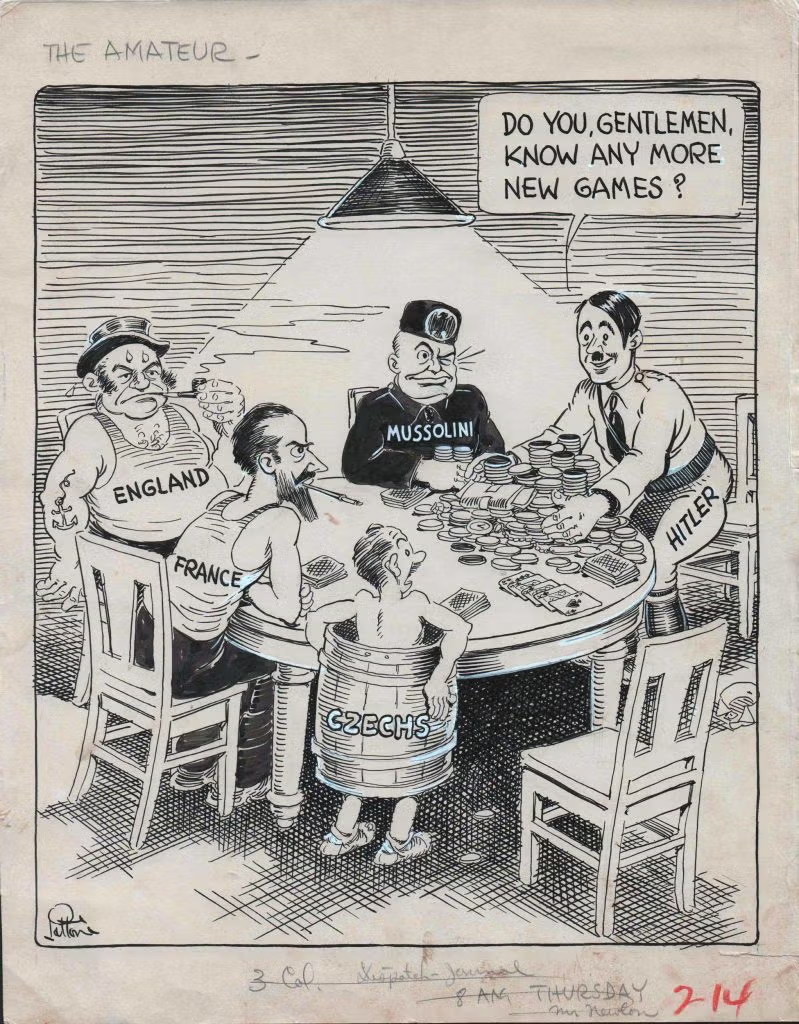
The expansionism inherent to all fascist regimes, which led Japan to invade Manchuria in 1931, Italy to do the same in Abyssinia in 1935, and finally, Hitler to annex Austria and conquer the Sudetenland, and shortly after, the rest of Czechoslovakia in 1938. These three countries abandoned the League of Nations in those years.
-
In 1939, Italy invaded Albania without anyone seeming to care.
In this state of affairs, the outbreak of war would be a matter of time.
-
The pacts also signaled aggression. Italy and Germany agreed to help General Franco in his coup d'état against the government of the Republic in Spain. France and England wanted at all costs to avoid being dragged into a major war and decided to remain neutral, while the USSR helped the Republic, but in exchange for large sums of money. Continuing with the policy of pacts, in November 1936, Japan and Germany signed the Anti-Comintern Pact to collaborate together against the expansion of communism, which other countries would later join. In May 1939, the Pact of Steel was signed between Mussolini and Hitler. The Rome-Berlin Axis was born. In August of that same year, Germany and the USSR signed the Ribbentrop-Molotov non-aggression pact. Here, it must be said that Stalin saw that the best way to ensure he was not invaded by Germany was to make a pact with them. The document included two key secret clauses: the two countries would divide Poland, and the USSR had a free pass to invade Finland, without German opposition. It was precisely the invasion of Poland (September 1, 1939) that made the United Kingdom and France decide to declare war on Germany on September 3.
-
Failure of the Appeasement Policy: Édouard Daladier and Neville Chamberlain, prime ministers of France and the United Kingdom respectively, did everything possible diplomatically to stop Hitler's expansionist ambitions, including looking the other way when he invaded Czechoslovakia (Munich Agreement, September 1938), but it was all in vain.
2. The Rapid German Expansion (1939-1942)
Simplifying a great deal, we can say that Germany started out winning the war and expanding rapidly across Europe until the Battle of Stalingrad (1942-1943), when the war took a complete turn and the Allies began to take ground from the Axis.
Let's start with the rapid German victories.
2.1. The Blitzkrieg (Lightning War)
Interestingly, in the first months after the invasion of Poland, there were practically no battles, despite the declarations of war. This is why the period between September 1939 and April 1940 has gone down in history as the "Phoney War." The belligerents were on standby, trying to analyze the enemy's weak points. Hitler basically wanted to use the same tactic as in the First World War: attack and defeat France very quickly in order to concentrate on a hypothetical war in the east (even though the USSR and Germany had signed the Ribbentrop-Molotov Pact, Hitler's future plans included the invasion of the Soviet Union). This time, the plan worked out better for Germany thanks to the use of the 'lightning war' (blitzkrieg), which consisted of invading enemy territory very quickly, first by weakening its defenses with bombing from the air force (the dreaded Luftwaffe) and then overwhelming what remained with infantry and tanks. In April 1940, Hitler, who wanted to seize the iron reserves of the Nordic countries, invaded Denmark and Norway, without the Allies doing anything about it. The anti-war British Prime Minister, Neville Chamberlain, resigned and his place was taken by Winston Churchill in May 1940. Starting in May, the Allies reacted, but very slowly. France felt safe behind its Maginot Line and left the Ardennes Forest almost unprotected, considering it impassable. But it was precisely there that the Panzer divisions entered, invading almost simultaneously the Netherlands, Belgium, Luxembourg, and France (May-June 1940). The German army cornered the British one at Dunkirk (northern France) and they had to escape by sea to England (Operation Dynamo). Meanwhile, in France, the northern half was occupied by the Nazis, and in the southern half, a collaborationist government, a puppet of Hitler, was established, headed by Marshal Pétain, a former hero of the First World War. This "French State," with its capital in Vichy, helped the Axis in all areas, including the extermination of Jews. The dissident General Charles de Gaulle went into exile in London and, from there, called on the French to resist and managed to solidify the Franco-British alliance.
In July, the Battle of Britain began. The tactic of Operation Sea Lion was the same: the Luftwaffe would bomb England to prepare for a naval invasion. Despite the bombings, England held out and thanks to the RAF (Royal Air Force), Hitler had to postpone his plan, although he continued with the submarine war, just as in the First World War.
By October, Italy wanted to continue conquering the Balkans from Albania, but failed in its invasion of Greece. Hitler, faithful to the Pact of Steel, went to Mussolini's aid, and by 1941, Yugoslavia and Greece had been invaded, and Slovakia, Hungary, Romania, and Bulgaria had become puppet states.
2.2. 1941-42: The Turning Point
In June 1941, Hitler set in motion a long-dreamed-of plan: Operation Barbarossa, the invasion of the USSR. Stalin thought the Ribbentrop-Molotov Pact was a guarantee of security, but he didn't count on Hitler's betrayal. By October, the Wehrmacht (German armed forces) and its allies (Italians, Romanians, Hungarians, etc.) had reached the outskirts of Moscow, but the fierce resistance of the Red Army—after a few initial months of disorganization, we've already discussed how Stalin's purges decimated the officer corps—and the Russian winter halted the German advance (Battle of Moscow, October 1941-January 1942).
The subsequent offensives in 1942 and 1943 proved that the Nazi army was not logistically prepared for an offensive that stretched from the Black Sea to the Arctic Ocean, and they failed after bloody battles, especially the Battle of Stalingrad (July 1942-February 1943), the bloodiest one, which cost over 2,200,000 lives and the Battle of Kurks (July-August 1943).
On the other side of the world, on December 7, 1941, the Japanese attack on Pearl Harbor took place, planned by General Tōjō after the sanctions imposed by the U.S. on Japan for the presence of Japanese military bases in French Indochina. Automatically, President Roosevelt declared war on Japan and joined the Allies. The two sides—the Axis and the Allies—were now fully configured.
3. The Allied Counterattack and the End of the War
3.1 The Axis Defeats in 1942 and 1943
As stated, the Battle of Stalingrad was decisive: the USSR began to reconquer its lands and liberate Romania, Bulgaria, Hungary, and the city of Warsaw from the Nazis (after the war, these countries would become part of the socialist bloc).
On the other hand, in North Africa, the Axis had launched an offensive led by the German Rommel (the Desert Fox) and his Afrika Korps to take the Suez Canal, but they were defeated in the Second Battle of El Alamein, Egypt (October-November 1942) by British troops under the command of General Montgomery. Furthermore, in the summer of 1943, the Allies penetrated southern Italy (Sicily Landings: Operation Husky), liberating the entire southern half. Mussolini was forced to resign by his king and arrested on July 25. In the north, a puppet state of Germany called the Italian Social Republic (RSI) was formed, with its capital in Salò. German paratroopers freed Mussolini from his arrest (Operation Oak) and put him at the head of the RSI in September 1943, but only nominally, as Hitler assigned his officers to tell the Duce what to do at every moment. This is the last episode of Mussolini's life: on April 25, 1945, an insurrection ended the RSI and three days later he was executed by firing squad by partisans.
3.2 The End of the War in Europe (1944-45)
On June 6, 1944, the largest amphibious operation in history took place: the Normandy Landings (D-Day). The Allies, with General Dwight Eisenhower in command, stormed and, after heavy Nazi resistance, captured a series of beaches in this region of northern France. The German defeat was total and produced a domino effect: Paris was liberated in August, the Netherlands in September, and Greece in October.
In December, the Germans launched their last major offensive (Operation Watch on the Rhine, also known as the Battle of the Bulge), but they were defeated in the Ardennes forest and had to retreat to their country. There, they suffered constant attacks and bombings from the Allies, who wanted Germany to surrender unconditionally. An example of this was the bombing of Dresden, a German city that no longer represented any danger and was razed by Allied bombs simply to accelerate the surrender in February 1945.This surrender was a matter of time: on April 24, Soviet troops entered Berlin and on the 30th, Hitler committed suicide in his bunker. Admiral Karl Dönitz, the same one who led the submarine war, succeeded him as President of Germany and prepared the unconditional surrender, which was signed between May 7 and 8.
The Duce did not fare much better in Italy: knowing that Germany was losing the war and could not guarantee his safety much longer, he tried to flee the dying RSI. While traveling in a car with a false identity, he was recognized at a roadblock by a group of partisans on April 27. The next day, he was executed and hung upside down at a Milan gas station alongside his mistress and three advisors. Italy had been liberated three days earlier, on April 25.
3.3 The End of the War in the Pacific
Japan carried out its own "blitzkrieg" after the attack on Pearl Harbor (remember: December 1941): in the first months of 1942 it invaded part of the Chinese coast, the French, British, and Dutch colonies (Burma, Thailand, Indochina, Malaysia, Indonesia) and the Philippine Islands, which was then an American dominion, defeating the Allied armies. However, between June 4 and 7, 1942, the Battle of Midway took place in the middle of the Pacific, where the United States decisively defeated Japan. Afterwards, between August and February of the following year, Japan was defeated again at the Battle of Guadalcanal and the Allies, commanded by General Douglas MacArthur, liberated, between 1944 and 1945, the islands previously invaded by the Japanese, including the Philippines. The imperial fleet was destroyed. However, faithful to the samurai code of honor, Japan did not plan to surrender and fought from its archipelago to the end. In 1944, the Shinpū Special Attack Unit appeared, better known as kamikazes, suicide pilots who crashed their planes into enemy targets, such as American aircraft carriers.
In July 1945, the new U.S. President, Harry Truman (Roosevelt had died in April), was at a crossroads: victory over Japan was only possible if the island was invaded or if atomic bombs were dropped. Faced with the prospect of the number of soldiers who would die in an invasion, he decided on the second option. The atomic bombs fell on Hiroshima and Nagasaki on August 6 and 9, 1945 (66,000 and 70,000 instant deaths, respectively). In between, on the 8th, the USSR declared war on Japan and invaded Japanese territories in Mongolia, China, and Korea. On the 15th, Emperor Hirohito announced the surrender, which was signed on September 2 aboard the USS Missouri in Tokyo Bay. The war was over.
4. Other Aspects of the War
4.1 The Persecution of Jews and Other Groups
Hitler had long expressed that the Jews—whom he identified with Bolshevism—were guilty of Germany's surrender in the First World War and all the misfortunes looming over the German people. The harassment of Jews had begun in the Interwar period, but when the NSDAP (Nazi Party) took over the government, it intensified. On September 15, 1935, the Nazi party unanimously approved the Nuremberg Laws, which prohibited offspring between Jews and those who had "German blood," in an obsessive attempt to seek a racial purity they considered fundamental for Germany's greatness.
Nazism divided society into Volksgenossen (comrades of the people, i.e., those of pure "German blood") and Gemeinschaftsfremde (aliens to the community), a heterogeneous group that included Jews, Roma, homosexuals, and people with physical or mental disabilities. Those who fit into this group were harassed, persecuted, or murdered.From the moment Hitler came to power in 1933, laws were enacted to remove Jews from public life: they were prohibited from teaching, practicing law, medicine, and other professions for clients who were not Jewish. Heinrich Himmler, leader of the SS, enforced the anti-Jewish laws harshly to please Hitler and out of personal conviction; in fact, the idea of an "Aryan race" was promoted more by him than by Hitler himself.
On November 9, 1938, Kristallnacht (The Night of Broken Glass) took place, during which businesses were attacked, synagogues were burned, and Jews were killed indiscriminately.
The concentration camps, created in 1933 mainly for communists, were also filled with Jews.
From 1941, Jews were forced to wear a distinctive badge on their clothes to set them apart from others. The most common were armbands or badges with the Star of David. Faced with the degrading conditions of their lives, many chose exile. In the autumn of that same year, with the intensification of the war, Hitler opined that cleansing Germany of Jews was costing too many resources and began to prepare the "Final Solution" (Endlösung der Judenfrage), which consisted of their complete elimination in Germany and in the countries it controlled. Anti-Judaism was not solely a German issue, and in many other countries (Vichy France, Romania, Poland...) this attitude was equally strong. In total, more than 40,000 concentration and extermination camps were built, to which they were taken in the so-called "death trains." In 1942, the plan to exterminate the Jews accelerated, and mass executions became frequent, especially in gas chambers where they were sprayed with Zyklon B (a gas based on hydrogen cyanide). Some of the infamously notorious concentration camps were Auschwitz (Poland), Buchenwald, and Dachau (Germany). In total, it is estimated that nearly six million Jews (two-thirds of those in Europe) died during the Holocaust, which is the name given to the German genocide of the Jewish people.
4.2 The Medical Experiments
In Nazi Germany, an intense campaign was carried out to cleanse society of people they perceived as "biological threats" in a deranged eugenics campaign. In addition to the Jewish Holocaust, mass sterilizations and various medical experiments on human beings—who had given no consent—were performed, which usually ended in death or lifelong sequelae.
The experiments can be divided into three categories:
-
Experiments related to the survival of Nazi military personnel: To test how long and how the organism could survive in extreme conditions, prisoners from concentration camps were used. They were subjected to parachute jumps from high altitudes to test from what altitude a parachute became inoperative. They were also forced to have their limbs frozen to test if hypothermia in soldiers could be cured.
-
Experiments with pharmaceuticals: Doctors tested new drugs on human beings to check their effects. Sometimes, inmates were infected with viruses or bacteria from diseases like malaria, typhus, tuberculosis, typhoid fever, yellow fever, and infectious hepatitis. They then tested medicines or vaccines to check their effectiveness. Bone and skin grafts or organ transplants were also tested.
-
Experiments to prove the superiority of the Aryan race or to create new races through genetic testing: The main idea was to establish how different races resisted contagious diseases. The doctor Josef Mengele, known as the Angel of Death, performed hundreds of tests, especially on twins, ranging from injections in the eyes to change their color permanently to "joining" twins to create conjoined twins. Doctor Herta Oberheuser also carried out horrendous dermatological experiments on prisoners. The forced sterilization of Jews and Roma was massive.
Once the war ended, the U.S. hired and naturalized about 700 Nazi scientists to work for them in what became known as Operation Paperclip. Some of them, like Wernher von Braun, participated in building the rockets that took man to the moon. The Soviet Union did the same (Operation Osoaviakhim), hiring and saving more than 2,500 technicians and scientists from any war crimes trial.
4.3 The Allies' Conferences
The leaders of the Allied countries held several meetings, either bilateral or trilateral. Here we will cite the most relevant, which were the tripartite ones (USSR, UK, USA).The first of these three-way meetings was the Tehran Conference (November-December 1943). There, Roosevelt, Churchill, and Stalin decided to open a major battlefront in Western Europe. The strategy, known as Operation Overlord, would eventually become the famous Normandy Landings. Furthermore, the three leaders agreed to divide Germany after the war and to create an international organization to maintain peace and security in the world; this would be the seed of the future UN (United Nations). Hitler plotted the assassination of the three leaders, but Soviet intelligence discovered the plan in time.
In February 1945, the second of these conferences took place in Yalta, Soviet Union. The same leaders met and agreed that, following the liberation of Europe, there would be democratic elections in all countries liberated from Nazism. They also decided to disarm and militarily occupy Germany and Austria among four powers: the U.S., USSR, France, and the UK, and to give Poland the territories adjacent to the Danzig Corridor. For its part, the USSR committed to attacking Japan, in exchange for which they would receive eastern Poland and Sakhalin Island.
Finally, the Potsdam Conference (Germany) brought together, between July and August 1945, Truman (Roosevelt had died in April), Churchill, and Stalin. Here, it was decided to return all territories occupied by the Nazis to their respective countries, the denazification and democratization of Germany, the occupation of Berlin and Vienna in four zones (USSR, U.S., UK, and France), the persecution of Nazi war criminals, the payment of war reparations by Germany (interrupted in the 1950s during the Cold War), and opposition to Spain's entry into the UN. During these meetings, some disagreements arose between Truman and Stalin that would be the prelude to the Cold War, a period of global bipolarization that lasted 45 years, until 1991.
4.4 Lebensborn
This was an organization created by Heinrich Himmler, leader of the Schutzstaffel (SS, or Protection Squadron), in 1935 to promote the birth rate, which had declined drastically after the First World War (from 30 births per 1000 inhabitants in 1900 to 15/1000 in 1930). For this purpose, shelters for single mothers were created, but only if they met the ideal of "pure German race" or "Aryan race." The eugenics project extended to countries annexed or conquered by Germany, especially Norway, and women of childbearing age who met the racial purity standards were encouraged to have children with SS officers. It is estimated that about 20,000 children were born under the project between 1935 and 1945. The singer Frida, from the group ABBA, is perhaps the most famous celebrity among them. After the Second World War, her mother and she fled to Sweden due to the stigmatization and harassment they received from their compatriots.
4.5 Unit 731
In occupied Manchuria, Japan developed a human experimentation laboratory similar to Joseph Mengele's in Germany. Unit 731 was a whole complex of buildings where experiments were carried out on prisoners of war, mostly Chinese. These were focused on investigating the human body's resistance to both diseases and extreme circumstances. Hence, the experiments included infections with bubonic plague or anthrax viruses, vivisections, or exposure to extreme temperatures to examine heat or frostbite damage, among others.
Shirō Ishii, the Japanese microbiologist who headed Unit 731, agreed to give information about the human experiments to the U.S. in exchange for not being tried or convicted.
4.6 Degenerate Art
Nazism, in its effort to control all aspects of society, set limits on artistic creations. A large part of contemporary art was banned, or its artists sanctioned and expelled from their jobs, especially if they were teachers, due to this policy.
It all began with an exhibition in Munich in 1937 called Entartete Kunst (Degenerate Art) in which works of art from expressionist or abstract movements were displayed from a ridiculing perspective to generate public rejection of these pictorial, sculptural, or musical manifestations. Often, they were associated with Judaism or communism to justify this opprobrium. Hitler himself said that this art was full of "obscenity, madness, blasphemy, and negritude." Some of the artists whose works were labeled "degenerate" were Van Gogh, Gauguin, Picasso, Modigliani, or Chagall, as well as all jazz music as a whole, which, paradoxically, enjoyed widespread popularity in Germany at the time.
4.7 Concentration Camps in the United States
In February 1942, shortly after the attack on Pearl Harbor and the declaration of war against the Japanese Empire, F.D. Roosevelt ordered the internment of 120,000 people of Japanese origin or ancestry in concentration camps across the country. These people were innocent and were interned solely because they could become potential enemies. Of them, 80,000 had been born in the United States and were therefore full citizens. This atrocity, which lasted until 1945, was not admitted or redressed until 1988, under the Reagan administration.
Simultaneously, 33,000 Japanese-Americans served in the U.S. military during the Second World War. Some Americans of German or Italian origin met the same fate.



朕󠄂深ク世界ノ大勢
ト帝國ノ現狀トニ鑑ミ非常ノ措置ヲ以テ時局ヲ收 拾セムト欲シ茲ニ忠
良ナル爾臣民


