
Unit 5:
The Cold War y el Franquismo
1. The World Divides into Blocs
1.1 The Capitalist Bloc and the Communist Bloc
In 1945, the Second World War ended. Among the victors, who had been allies until that point, there were two powers with antagonistic political ideologies. Furthermore, they sought to maintain and even increase their power and influence, drawing the rest of the world's countries into taking positions for or against them. These countries were the United States (capitalist system) and the Soviet Union (communist system). The polarization was so pronounced that Winston Churchill, the former Prime Minister of the United Kingdom, stated that an "iron curtain" had descended across Europe.
Both the USA and the USSR implemented measures to consolidate their power and gain allies. These were:
On the part of the USA:
-
The Truman Doctrine (1947): President Harry Truman committed to providing economic and military aid to any country wishing to combat communism.
-
The Marshall Plan (1947): The USA granted large sums of money to the countries of Western Europe for post-war reconstruction. Through this, it gained allies, economic partners, limited the influence of communism, and revitalized the European economic market, from which the USA also benefited.
-
The North Atlantic Treaty Organization (NATO, 1949): This is an alliance for mutual military assistance between member countries. It was created specifically with the possibility of a Soviet invasion of a Western European country in mind.
On the part of the USSR:
-
During the Tehran, Yalta, and Potsdam conferences, Stalin demanded that the USSR have a "security buffer" against potential attacks from Western Europe. Thus, the governments of the German Democratic Republic (GDR), Poland, Hungary, Romania, Bulgaria, Czechoslovakia, and Albania, while independent, were sympathetic to and dependent on Moscow.
-
The Council for Mutual Economic Assistance (COMECON, 1949), through which member countries provided each other with financial aid and traded among themselves.
-
The Warsaw Pact (1955): A military alliance between member countries. It is the communist equivalent of NATO.
1.2 Politics and Economy of Both Blocs
In the capitalist bloc, governments are republics or parliamentary monarchies, constitutionalist and multi-party. There is, in general, respect for fundamental liberties and rights:
-
Right to life
-
Right to marry
-
Right to property
-
Right to information
-
Right to education
-
Right to strike
-
Equality before the law
-
Freedom of expression
-
Freedom of association in trade unions
The economy is mixed, though with a predominance of free-market capitalism.
Spain and Portugal were dictatorships and did not respect all these rights and freedoms, but they were allowed to belong to this bloc for being openly anti-communist.
In general, the capitalist bloc encompassed all of the Americas (except Cuba), Western Europe, Japan, Oceania, and some countries in Asia and Africa—continents where it disputed spheres of influence with the communist bloc.
In the communist bloc, governments were dictatorial republics, ruled by communist parties that were highly dependent on, or directly puppets of, the Communist Party of the Soviet Union (CPSU). The liberties and rights of citizens were subordinate to the "interests of the working class," which in practice meant the policy of the single party.
In general, the communist bloc consisted of the USSR, Eastern Europe, China (though its case is very particular, as we will see), Cuba, North Korea, plus some countries in Southeast Asia and Africa. In Asia and Africa, it maintained disputes over spheres of influence with the capitalist bloc.
1.3 The Non-Aligned Countries
There existed, and still exists, a third bloc of countries that refused to adhere to either the capitalist or communist bloc. They are known as the Non-Aligned Countries.
The organization emerged at the First Summit of the Non-Aligned Movement (NAM) in Belgrade (1961), promoted by leaders such as Josip Broz "Tito" (Yugoslavia) and Gamal Abdel Nasser (Egypt). Some of the Non-Aligned Countries were: India, Egypt, Yugoslavia, Indonesia, Ghana, Algeria, Mexico, and Argentina.

From the Baltic
to the Adriatic, an iron
curtain has descended
across the Continent


2. The Chinese Revolution and the Transition to Communism
China’s millennia-old imperial system collapsed in 1912, when the Republic was proclaimed. Two rival political parties then emerged, the Nationalists and the Communists, and their hostility grew until the Chinese Civil War began in 1927. In 1949, Mao Zedong’s Communists definitively defeated the Nationalists led by Chiang Kai-shek, and from that point on the country became what is now the People’s Republic of China. At first, it was allied with the communist bloc and very close to Stalin, although this would change over time.
Mao Zedong established a one-party dictatorship (the Chinese Communist Party), curtailed freedoms and rights, but guaranteed certain basic services to the population (housing, education, food). The USSR provided economic and material assistance to China during its transition to communism, but after Stalin’s death in 1953, relations between the two countries cooled, as Mao believed that Khrushchev, Stalin’s successor as leader of the USSR, was too reformist.
In 1958, Mao launched the so-called Great Leap Forward, an ambitious project to industrialize the country by forcing peasants to set up home furnaces to produce steel, using any metal material they could put inside.
He also organized peasant families into communes in order to increase production, but planning was very poor. In some areas the land was overexploited until it became infertile, and, on the other hand, the lack of individual incentives —since all the fruits of labor were collective— did not encourage the Chinese to produce more.
Overall, the Great Leap Forward was a huge failure: the steel produced in the home furnaces was so poor in quality that it broke almost immediately, and agricultural production declined. Although figures were falsified out of fear of Mao’s anger, reality could not be hidden: between 15 and 50 million people died of hunger. In addition, the USSR was no longer providing economic aid. In 1962, the project was cancelled and the subject was no longer discussed.
In 1966, in order to regain influence after the failure of the Great Leap Forward, Mao launched the Cultural Revolution, which consisted of carrying out a massive propaganda campaign in his favor. During the Cultural Revolution, thousands of people were persecuted and executed for being suspected of anti-communism or counterrevolutionary activities, and practically any aspect of life that could be considered non-Maoist was eliminated: books, traditions, art, scientific advances, temples. Many people were sent to “reeducation” camps to be “cured” of having a “bourgeois mentality".
The Little Red Book, in which Mao set out his political ideas, was published in 1964 and was compulsory reading in schools. Members of the Chinese Communist Party were also required to carry a pocket-sized copy. In 1976, Mao died, and a second modernization of China began, very successful economically, but without ceasing to be a one-party dictatorship.
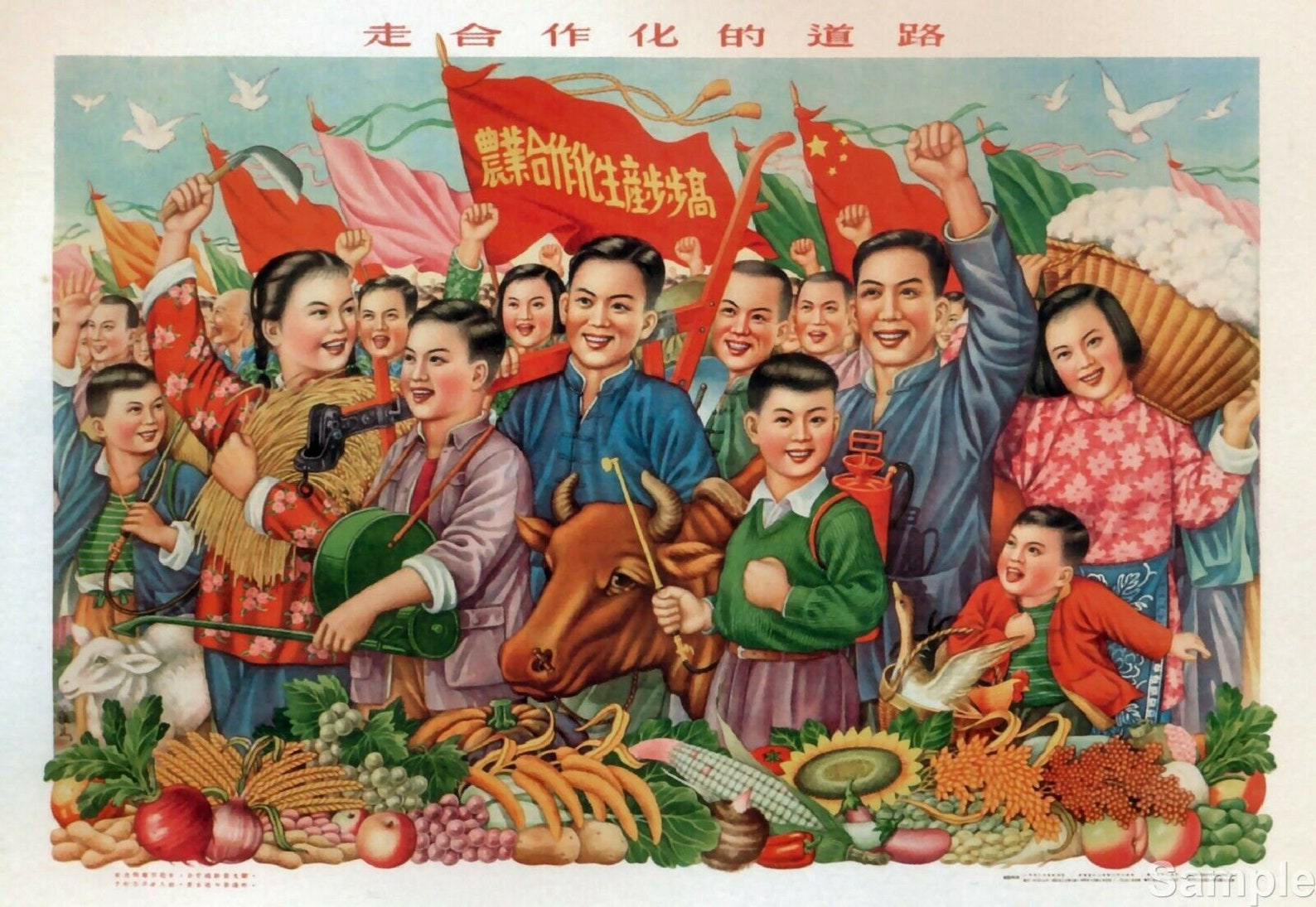
Great Leap Forward
propaganda at its finest


Mao, AKA the Great Helsman
Communism
is not love. Communism
is a hammer which we use
to crush the enemy
3. Latin America
The history of Latin America in the 20th century is that of a subcontinent gripped by great turmoil: authoritarian governments and dictatorships of all kinds occurred in practically every country. The influence of the United States over this region was and is very powerful. Recall that in 1823, President James Monroe declared himself against European interference in any country in the Americas ("America for the Americans"), which amounted to saying that the only external influence in a Latin American country he intended to allow was his own.
After the Second World War, numerous Marxist-inspired movements appeared here andt here across the continent, but the U.S. attempted to eliminate them by subsidizing anti-communist movements and using state terrorism if necessary. This political-military strategy was named Operation Condor and was behind the establishment of anti-communist dictatorships such as those in Chile, Argentina, and Uruguay, among others. It is estimated that Operation Condor claimed between 60,000 and 80,000 lives. The only country that managed to resist the American attacks and blockades was Cuba, where Fidel Castro led a communist revolution that took power in 1959. This form of government continues today under the leadership of Miguel Díaz Canel.

Fidel Castro, revolutionary and Cuban dictator
4. The Cold War (1947-1991)
As already stated in point 1, after the Second World War the world split into the communist bloc and the capitalist bloc, or, in other words, the USSR against the USA, each with their respective allies (recall NATO and the Warsaw Pact).
One of its main characteristics is that a direct confrontation between the two powers never occurred. However, wherever there was a conflict between communists and capitalists, both sides sent troops, money, and advisors. This happened in Greece, Korea, Vietnam, etc.
During these years there were periods of higher and lower tension, but both the USA and the USSR conducted hundreds of nuclear tests. The military strategy of both countries was known as "MAD" (Mutual Assured Destruction), meaning that if one country attacked with nuclear power, the other would respond with equal force, thus destroying each other. In this way, they were deterred from attacking. The fear of a nuclear attack was so great that there were even drills in schools (duck and cover) and survival manuals were distributed to the population.
Let's divide this era into three periods:
4.1 The First Conflicts:
-
Greek Civil War (1946-1949): It pitted monarchists against communists; it was a conflict that began during the Nazi occupation, between collaborators and resistance fighters. The UK and USA supported the monarchists, and the USSR, Albania, and Bulgaria supported the communists. Ultimately, the monarchists won in 1949.
-
Division of Germany (1949): After years of occupation, Germany was divided into the Federal Republic of Germany (FRG) in the west (capitalist) and the German Democratic Republic (GDR) in the east (communist). The city of Berlin was located within the GDR but was itself divided into West Berlin (an enclave of the FRG) and East Berlin. The repressive policies of the GDR, dependent on the USSR, caused two and a half million people to leave East Berlin and seek asylum in West Berlin between 1945 and 1961, the year the infamous wall separating the two parts of the city was erected. The "Wall of Shame," as it was called in West Berlin, or the "Anti-Fascist Protection Wall," as it was called in East Berlin, stood until 1989.
-
Korean War (1950-1953): After the Second World War, Korea was divided into two parts: the north, under Soviet and Chinese influence, and the south, under American influence. In 1950, the north tried to conquer the south, which was heavily aided by the USA. Finally, an armistice was signed in 1953, but not a peace treaty, so officially this war has not yet ended.
-
Nationalization of the Suez Canal (1956): Egyptian President Gamal Abdel Nasser decided to nationalize the canal, severely harming the UK and France, who were the main shareholders of the companies managing the Canal. Nasser was not a communist, but he was anti-imperialist, and he requested specific support from the USSR in the face of pressure from the UK and France. Nevertheless, Nasser was one of the leaders of the Non-Aligned Movement.
4.2 Years of Calm... Or Not So Much.
-
The Failed Bay of Pigs Invasion and the Cuban Missile Crisis: In 1961, President Kennedy organized the invasion of Cuba to eliminate Fidel Castro and communism from the island, but it failed resoundingly at the Bay of Pigs. This strained international relations, as the USSR decided to strengthen ties with Cuba. In 1962, an American spy plane photographed Soviet missiles aimed at the USA installed in Cuba. This brought the world to the brink of a Third World War, which would have been an extremely destructive nuclear war. Finally, after thirteen days of tense negotiations between Khrushchev and Kennedy, it was decided that the USSR would withdraw its missiles from Cuba if the USA withdrew its missiles aimed at the USSR from Italy and Turkey. The meetings initiated a period of relative peace and even led to the inauguration of a direct telephone line from the White House to the Kremlin, the famous Red Phone.
-
The Arab-Israeli Conflict: In 1947, the UN approved Resolution 181 to divide Palestine into two parts: one for Palestinians and one for Jews. Palestine rejected the resolution and wars began immediately: one between 1948-1949, the Six-Day War in 1967, and the Yom Kippur War in 1973. Furthermore, during the 1972 Munich Olympics, an armed Palestinian group kidnapped a group of Israeli athletes who ultimately died during the rescue operation. The USA always supported Israel and the USSR supported Palestine. This conflict continues today.
-
Vietnam War (1955-1975): In 1954, France withdrew from Indochina and Vietnam was divided into two countries: the north, communist; and the south, capitalist. The north, with its political-military force, the Vietcong, tried to unify the two countries under a communist regime, and the USA decided to enter the war to help the south. The war was bitter and bloody, with the use of napalm bombs against civilians and millions of dead. Finally, in 1975, the USA was defeated and withdrew with a toll of 58,000 dead and more than 300,000 wounded. North Vietnam unified the country and other countries in the region, such as Laos and Cambodia, adopted communist regimes.
